numbers and benchmarks
How many screening slots per day can one mammography unit realistically hold in our center?
How to calculate true throughput for a screening unit from exam time, room turnover, technologist availability and no show rate, so your template reflects the machine rather than wishful thinking.
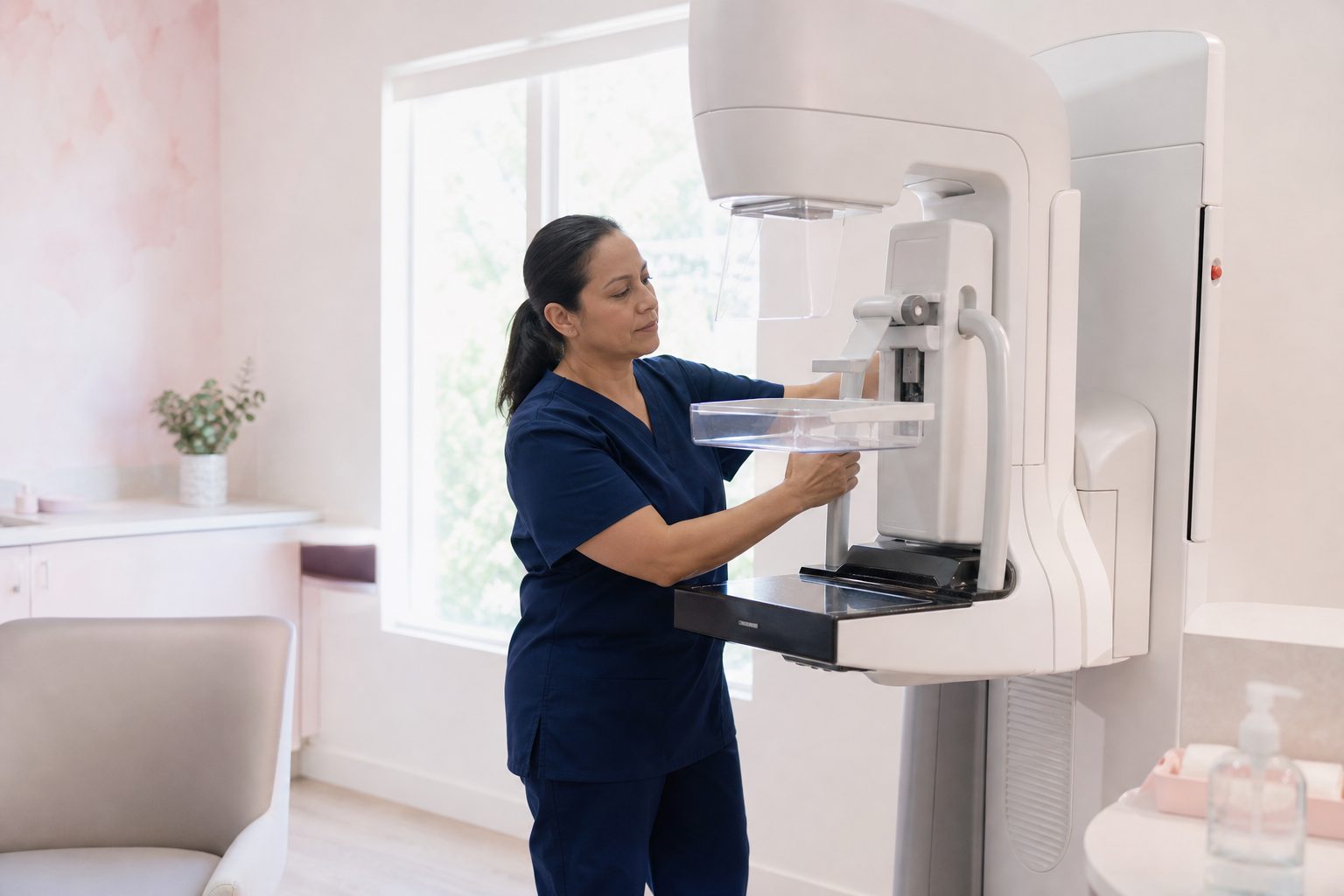
For a single screening unit staffed by one technologist through an eight hour day, most independent centers land somewhere between 20 and 30 completed screening exams. The spread is wide because the number is not a property of the machine. It is a property of your slot length, your technologist coverage, your room turnover discipline, and how much of the day you have committed to diagnostic work.
The useful version of this question is not "what can a unit do" but "what can my unit do on a normal Wednesday, with the staff I actually have, including the ten minutes the phantom takes." That number you can build yourself in about twenty minutes, and once you have it, your template stops being aspirational.
The components of a screening slot: positioning, imaging, dressing, room reset
A screening slot is not the exam. Time the whole thing from the moment the technologist calls the patient's name to the moment the room is ready for the next one, and you get four blocks.
- Greeting, history, changing. Confirming identity and date of birth, reviewing the intake form, prior surgeries, implants, symptoms, and getting her gowned. Roughly 3 to 5 minutes, longer for a first visit or a language line call.
- Positioning and acquisition. Four standard views, CC and MLO on each side. Positioning is the skilled part and it is where quality is won or lost. Around 6 to 10 minutes depending on body habitus, implants and patient mobility.
- Image review and release. The technologist checks each view for positioning and motion before letting the patient dress, and repeats anything inadequate. 2 to 4 minutes, occasionally much more.
- Dressing and room reset. Wiping the paddle and detector surface, fresh linen, disposing of the gown, entering notes. 2 to 4 minutes.
Add the middle of those ranges and you get roughly 18 minutes of real work. That is why 20 minute screening slots are common and why 15 minute slots only hold in centers with two changing rooms, a dedicated aide, and a technologist who never touches the front desk.
The parallelism trick
The biggest single lever on slot length is whether the next patient can undress while the current one is being imaged. Two changing cubicles attached to one screening room turns three or four minutes of serial time into zero. If you are trying to move from 20 to 15 minute slots, look at your room layout before you look at your technologist.
Keep reading: What should I say when a patient calls back scared about being asked to return for more images?
2D versus tomosynthesis and what it does to slot length
Tomosynthesis adds acquisition time per view and, more importantly, adds a longer breath hold and a longer compression period for the patient. On most current systems the combined 2D plus tomo acquisition per view is measurably longer than 2D alone, and in a four view screen that difference compounds.
The practical effect at the schedule level is usually one to three minutes per patient, not ten. Time it on your own unit rather than trusting a vendor figure: run a stopwatch on ten consecutive screens and take the median, not the average, because one difficult positioning will skew the mean.
Where tomo genuinely changes your day is downstream. A lower recall rate means fewer diagnostic callbacks to fit in, which frees the capacity you were holding for them. So a center that converts fully to tomosynthesis may lose a minute or two per screening slot and get some of it back in the diagnostic block.
Technologist staffing as the real ceiling
The unit does not take breaks. Your technologist does, and federal law aside, a mammographer who positions thirty women without a break produces worse images by the afternoon.
Count the honest available minutes in a shift:
| Item | Minutes |
|---|---|
| Scheduled shift, 8:00am to 4:30pm | 510 |
| Unpaid meal break | -30 |
| Two rest breaks | -30 |
| Opening: system warm up, worklist check | -15 |
| Daily quality control | -20 |
| Closing: shutdown, room stock, notes | -15 |
| Available imaging minutes | 400 |
At 20 minute slots that is 20 screening exams, not 25. This is the arithmetic most templates get wrong: they divide the shift by the slot and forget everything that is not imaging. The 400 figure above is an assumption built from typical values, so rebuild it with your own shift and QC times.
If you have a second technologist overlapping for part of the day, you do not double capacity unless you also have a second room. A second technologist on one unit buys you continuous imaging through lunch and breaks, which on the table above is worth about 60 minutes, or three more screens.
Keep reading: How did one independent center bring its lapsed annual screening patients back in a year?
Building an overbooking factor from your own no show rate
Overbooking a screening template is defensible in a way that overbooking a diagnostic template is not, because a screening exam is short, standardized, and can absorb a modest queue without harm. The question is how much.
Take your own completed no show rate over the last three months. Suppose it is 9 percent. The naive move is to add 9 percent more slots. That is too aggressive, because no shows are not evenly distributed: Monday mornings and the day after a holiday cluster badly, and a fully attended overbooked day means someone waits thirty minutes in a gown.
A more usable rule: overbook at roughly half your no show rate, rounded down to whole patients, and place the extra bookings only in the parts of the day where you have a natural buffer. On a 20 slot day with a 9 percent no show rate, that is one extra booking, placed mid morning where a small overrun can be absorbed before lunch.
Then measure the consequence, not the intention. Track two numbers for a month: the count of days you finished on time, and the count of patients who waited more than fifteen minutes past their appointment time. If the second number moves, back the overbooking off.
Reserving capacity for diagnostic callbacks and short interval follow ups
Screening capacity is not the only claim on the room. Every batch of screens generates recalls, and those women need a diagnostic appointment quickly. Six month short interval follow ups for probably benign findings arrive on a predictable clock too, and they are time sensitive in a way that annual screening is not.
Estimate the demand from your own recall rate. If you complete 100 screens a week and recall 9 of them, you need roughly 9 diagnostic slots a week for that cohort alone, before adding symptomatic patients and follow ups. Diagnostic slots run longer, commonly 30 to 45 minutes, because they include additional views, possible ultrasound and a radiologist reading while the patient waits.
Two ways to hold that capacity, and the choice matters:
- Blocked days. Dedicate specific half days to diagnostics. Efficient for the radiologist, who batches reads, but the patient recalled on a Friday may wait until Tuesday.
- Reserved daily slots. Hold two or three diagnostic slots every day, released to screening if unused by a set cutoff, say 48 hours out. Slower for the radiologist, much faster for the anxious patient.
Whichever you pick, write down the release rule and enforce it. Reserved slots that nobody ever releases are just empty capacity with a polite name.
See how MammoLoop handles this for breast imaging and women's screening centers
Downtime you must plan: quality control, service, accreditation phantom work
Mammography units operate under the Mammography Quality Standards Act, which is what makes this category of downtime non negotiable rather than a nice to have. Daily and weekly quality control tests, the phantom image evaluation, compression testing, the annual medical physicist survey, and the accreditation body's periodic image submissions all consume room time.
Two planning rules follow. First, put daily QC in the template as a real block at the start of the day, not as something the technologist squeezes in while a patient waits. Second, schedule the annual physicist survey and any preventive maintenance on a deliberately light day and block the room, rather than hoping it fits between patients. A service visit that runs long on a full day costs you the whole afternoon.
Budget realistically: daily QC plus the weekly and monthly tasks amortized comes out to something close to 20 to 30 minutes a day on most units. Add unplanned service downtime. If your unit has had two half day outages in the past year, that is about 0.4 percent of your annual capacity, which is small but real when you are promising referrers a two week lead time.
Turning the number into a schedule template you can hold to
Put it together for one unit, one technologist, an 8:00 to 4:30 shift, 20 minute screening slots and tomosynthesis:
- Available imaging minutes: 400.
- Divide by slot length: 400 divided by 20 equals 20 slots.
- Subtract reserved diagnostic slots: hold 2 at 30 minutes, which consumes 60 minutes, leaving 340 minutes, or 17 screening slots.
- Add overbooking at half your no show rate: 17 times 4.5 percent is under one, so add one on the days you have historically run light.
- Template: 18 screening appointments and 2 held diagnostic slots per day.
Eighteen will feel low to anyone used to seeing 25 on the template. The difference is that 18 gets completed. A template of 25 that finishes 19 exams and runs forty minutes late produces a stressed technologist, waiting patients and a scheduler apologizing all afternoon.
Recheck the number twice a year, and any time you change equipment, staffing or room layout. Then check the assumption underneath all of it: a template only pays off if the slots are full. Capacity you calculated carefully and then leave empty because last year's patients did not come back is the more expensive problem.
That is the gap MammoLoop is built to close. It keeps every woman due for her annual screen on a live recall list, sends the staged text and letter reminders that get her booked, and pushes missed appointments into a recovery queue so your carefully built 18 slots are actually 18 completed exams.
Next step
Run this recall work once, on a schedule that holds
MammoLoop keeps the twelve month recall cohort current, sends the staged texts and letters, and hands your scheduler a short callback queue instead of a printout. Bring one month of screening volume to the call and we will walk your own numbers.
Read also

What should I say when a patient calls back scared about being asked to return for more images?
A front desk checklist for diagnostic callback calls: what a scheduler may and may not say about results, how to book the visit quickly, and how to keep an anxious patient from canceling.

How did one independent center bring its lapsed annual screening patients back in a year?
A working account of how a two room breast imaging center rebuilt its recall process, reassigned scheduler time, and returned lapsed annual patients to the books over four quarters.

What does a day at the front desk of a busy screening center actually look like now?
An hour by hour account of the scheduler's day at an independent women's imaging center, from the morning callback list to the end of day reconciliation of arrivals and no shows.